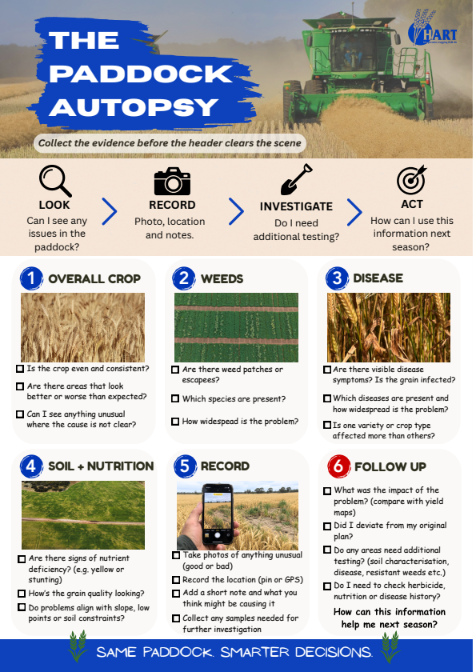
Harvest is the perfect time to reflect on the growing season and capture valuable paddock observations before the evidence disappears.
Developed as a practical resource for growers, The Paddock Autopsy provides a simple checklist to help identify, record and investigate crop performance, weeds, disease, soil and nutrition.
From taking photos and recording observations to identifying areas that may need further investigation, this handy guide will help turn this season's findings into valuable insights to support better decision-making in future growing seasons.
Download The Paddock Autopsy PDF and make the most of what your paddocks can tell you before harvest wraps up.
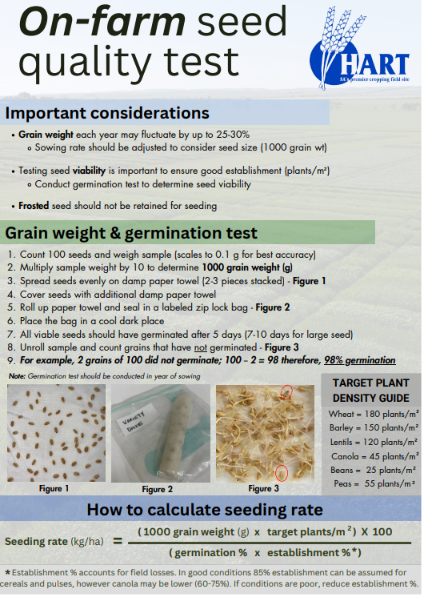
Understanding seed quality is an important step in achieving successful crop establishment and determining appropriate seeding rates.
This practical factsheet provides growers with a simple, step-by-step guide to assessing on-farm seed quality, including:
- Measuring grain weight and calculating 1000 grain weight
- Conducting a germination test to assess seed viability
- Calculating seeding rates based on grain weight, germination percentage and expected establishment
- Understanding how seed size and quality can influence crop establishment
The resource also includes a target plant density guide and visual examples of grain quality differences in wheat and barley.
Download the On-Farm Seed Quality Test factsheet to help make informed seed selection and sowing decisions for future growing seasons.
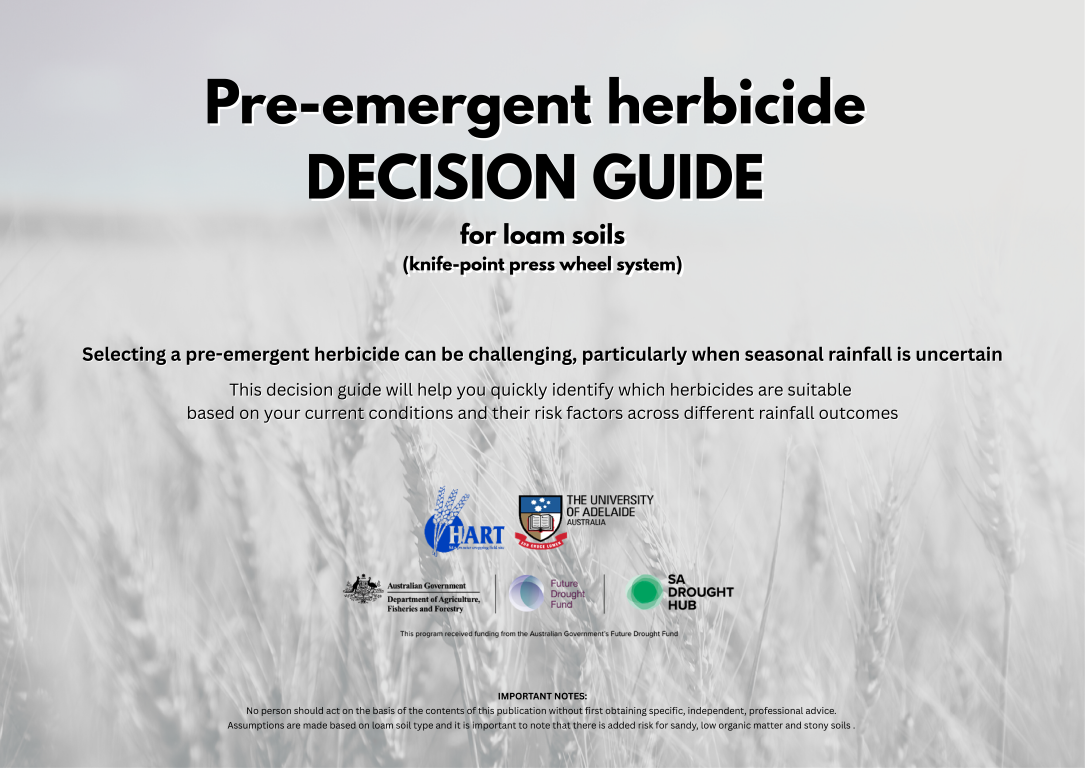 PRE-EMERGENT HERBICIDE DECISION GUIDE
Selecting a pre-emergent herbicide can be challenging, particularly when season rainfall is uncertain.
This decision guide will help to quickly identify what herbicides are suitable based on your current conditions and their risk factors across different rainfall outcomes.
We've put together two really easy to read charts, one for wheat and one for barley, using simple colour-coding to help you assess crop safety, expected levels of grass weed control, a rating for herbicide mobility and some concise notes as a further explainer.
This guide has been put together using expert advice with funding gratefully received from the SA Drought Hub in alignment with work being undertaken on the GRDC RiskWi$e project.
Download it here: Pre-emergent herbicide decision guide
 Crop Establishment and Precision Planting
How can we improve crop establishment?
This booklet will help growers better understand reasons for poor and uneven establishment. It consists of three sections:
- A summary of some of the environmental and management factors that influence the rate and uniformity of crop establishment.
- Six grower case studies from the southern and western regions who share their tips and crop establishment experiences.
- Recent experimental work that has assessed the benefits of precision planting in winter grain crops in the southern and western regions.
Download it here: Crop Establishment and Precision Planting
 Hart long-term seeding systems trial - a summary of 22 years of research
When we produced the first edition of this booklet in 2016, then Hart vice-chairman Justin Wundke wrote the foreword and much of what he said still rings true.
The decisions we make when upgrading our seeding system, whether new or second-hand, can have a significant impact on many aspects of our farming operations.
This trial features comparisons between three seeding systems, considering more than just yield, and after 22 years it has come to an end. Not only have we updated the data, we've also caught up with all five farmers from the original case studies to see how their systems have changed (or not).
We think you'll find it a really interesting read - you can download the latest edition here.
The first edition, published in 2016, can be found here: Hart long-term seeding systems trial 2016
And if you like, check out this 4 minute video clip from 2015 (thanks to SAGIT) as we sowed the trial for the 16th year.
Timely operations are key to maximising farm profit and sowing is one of the most time-critical operations. This is because of the yield penalty associated with delayed sowing in most regions.
Find out more about this other important factors that can influence wheat yield potential and profit in this publication produded by the GRDC.

Improving pre-emergent herbicide spray coverage in stubble retention systems
How does stubble effect spray coverage?
Will the herbicide wash off the stubble?
Tips to improve your spray coverage
Are there other ways to manipulate your spray setup and improve coverage?
The Hart Field-Site Group thanks the University of Adelaide weeds team and Bill Gordon for assistance with trial development for this project. We also gratefully acknowledge SAGIT for project funding (H114).
Over five seasons Hart and other farming systems groups in the Southern region have investigated whether soil carbon (C) content can be increased through stubble retention +/- additional nutrients to assist the breakdown of stubble.
At the conclusion of five years the project was unable to demonstrate differences in soil C between the stubble and nutrient treatments.
To view the key points and soil C results, see “Soil Organic Matters” Factsheet #4.
This project was funded by Australian Government and GRDC (CRF00002).

Nitrogen management in wheat 2017
Why are nitrous oxide emissions an issue?
Under what condition in cropping are emissions more problematic?
Nitrogen management in wheat
Using new technologies to visualise crop nitrogen demand
2027
Getting The Crop In seminar
Wednesday, March 10, 2027
8am - 12:30pm | Clare, SA
Winter Walk
Tuesday, July 20, 2027
9am - 12pm | Hart, SA
Hart Field Day
Tuesday, September 21, 2027
Hart, SA
Spring Twilight Walk
Tuesday, October 19, 2027
5pm | Hart, SA